











Outdoor Fiber Optic Cable
What Is Outdoor Fiber Optic Cable
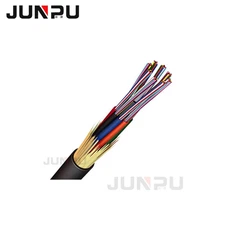
Outdoor fiber optic cable is a type of cable designed to withstand outdoor environments and protect the delicate fiber optic strands inside. It is typically used to provide high-speed internet, telephone, or cable TV services in residential or commercial buildings. The cable is usually composed of an inner core made of glass or plastic fibers that transmit data signals at high speeds, surrounded by protective layers that provide resistance to environmental factors such as water, temperature, and physical damage. Outdoor fiber optic cable can also be aerial, buried, or submerged, depending on the installation requirements.
Advantages of Outdoor Fiber Optic Cable
Signal Transmission Over Longer Distances: Outdoor fiber optic cables can transmit data over long distances without losing signal quality, which makes them ideal for long-haul data transmission.
Immune To Electromagnetic Interference: The fiber optic cables are immune to electromagnetic interference, which means that they are the best option for areas with high electromagnetic activity, like cities and industrial areas.
High Bandwidth Capacity: Outdoor fiber optic cables have a higher capacity than their competing copper cables, making them a better option for high-bandwidth applications like streaming video and online gaming.
Durable And Strong: Outdoor fiber optic cables are built to withstand harsh weather conditions, including high winds, extreme temperatures, and exposure to UV light.
Enhanced Security: Fiber optic cables are more secure than copper cables as they are difficult to tap and intercept, making them a preferred choice for high-security applications.
Stronger Signal Transmission: With fiber optic cables, light signals transmit over longer distances with no distorted signals or loss of power.


Why Choose Us
Why Choose Us
Professional sales team and engineer team provide professional technical Support,Test video and Sample support
Advanced Equipment
Equipment based on the latest technological developments has higher efficiency, better performance and stronger reliability.
One-stop Solution
With rich experience and one-to-one service,we can help you choose products and answer technical questions.
Innovation
We are dedicated to improving our systems continually, ensuring that the technology we offer is always cutting edge.
High Quality
Our products are manufactured or executed to very high standards, using the finest materials and manufacturing processes.
Competitive Price
We have professional sourcing team and cost accounting team, stive to reduce cost and profit and provide you a good price.
Types of Outdoor Fiber Optic Cable
There are several types of outdoor fiber optic cables available, each designed for specific applications and environments. Here are some of the main types of outdoor fiber optic cables:
LT cables are designed for installation in ducts or conduits and contain individual buffer tubes filled with gel or water swellable compounds to protect the fibers from water ingress.
These cables are suitable for both indoor and outdoor applications and are often used as drop cables from a distribution cable to a customer premises. I/O cables have a rugged outer jacket suitable for outdoor use and are often used for aerial installations.
Armored cables contain a metallic armor layer to provide extra protection against rodents, insects, and other forms of mechanical damage. They are suitable for outdoor installation, particularly in areas with harsh conditions.
Ribbon cables are designed to carry multiple fibers in a single unit. They are often used in high-density applications where many fibers need to be installed in a small space. Ribbon cables can be found in both indoor and outdoor versions.
Aerial cables are designed for installation on utility poles or other overhead structures. They are typically lightweight and flexible to withstand outdoor elements and are often protected by a non-metallic strength member.
Duct cables are designed for installation in underground or indoor duct systems. They are flexible and can be easily pulled through ducts and conduits.
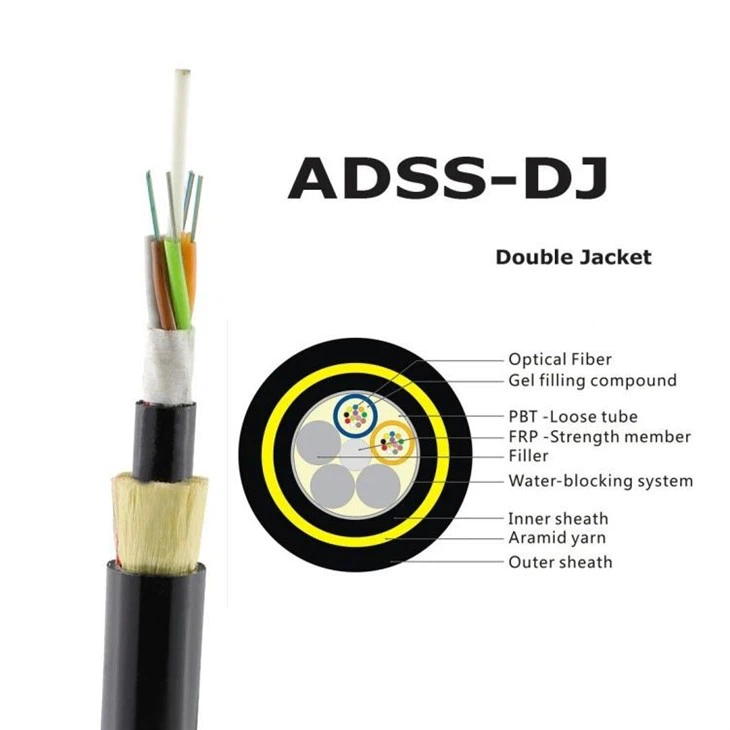
What Are The Main Components Of Outdoor Fiber Optic Cable
The main components of outdoor fiber optic cables include:
Fiber: The core of the cable, which carries the light signals. It is typically made of glass or plastic and is very thin, with diameters in the range of 8 to 125 micrometers. The core may be surrounded by a buffer material to protect it from mechanical damage.
Primary Jacket: The outermost layer of the cable that provides protection against environmental factors. It is usually made of a durable material such as polyvinyl chloride (PVC), polyethylene (PE), or a combination of both. The jacket must be resistant to UV radiation, temperature variations, and physical abuse.
Strength Members: These are typically made of Kevlar or other strong, synthetic fibers to provide additional tensile strength and prevent the cable from stretching or breaking under mechanical stress.
Secondary Jacket or Armor: Some outdoor fiber optic cables may have an additional layer of protection, such as a metal braid or a tight-buffer coating, to provide extra shielding against electromagnetic interference (EMI) and to enhance the cable's durability and flexibility.
Grommets and Fittings: These are accessories used to protect the cable where it passes through walls, panels, or other structures, and to maintain the cable's integrity.
Connectors: At each end of the fiber optic cable, there is usually an optical connector that allows the cable to be connected to other fibers or to equipment such as transceivers, switches, or routers. Connectors must be weather-proof to prevent moisture from entering the connection.
Cable Management Components: These include items like cable trays, raceways, or conduit that are used to route and secure the cable, ensuring it is safely installed and protected from physical damage.
What Are The Applications Of Outdoor Fiber Optic Cables
Outdoor fiber optic cables have a wide range of applications, including:
Telecommunication Networks
Outdoor fiber optic cables are widely used in telecommunication networks to transmit high-speed data, voice, and video signals over long distances. They are used in long-haul networks, metropolitan area networks (MANs), and local area networks (LANs).
Internet Service Providers (Isps)
Outdoor fiber optic cables are essential for ISPs to provide high-speed internet connectivity to residential and commercial customers. They are used to connect the central office to customer premises, enabling the delivery of broadband services.
Cable Television (Catv) Networks
Outdoor fiber optic cables are used in CATV networks to deliver high-quality video and audio signals to subscribers. They are used for long-distance transmission and distribution of cable TV signals.
Surveillance And Security Systems
Outdoor fiber optic cables are used in surveillance and security systems to transmit video signals from cameras to monitoring stations. They provide high bandwidth and long-distance transmission capabilities, ensuring the delivery of high-resolution video footage.
Oil And Gas Industry
Outdoor fiber optic cables are used in the oil and gas industry for various applications, including monitoring and control of pipeline systems, offshore drilling platforms, and remote sensing of environmental conditions. They provide reliable and secure communication in harsh and remote environments.
Transportation Systems
Outdoor fiber optic cables are used in transportation systems, such as railways, highways, and airports, for various applications. They are used for traffic control and management, communication between control centers and field devices, video surveillance, and passenger information systems.
How To Choose The Right Outdoor Fiber Optic Cable
Choosing the right outdoor fiber optic cable is crucial for ensuring reliable and high-speed communication for outdoor applications. Here are some important factors to consider when selecting the right outdoor fiber optic cable:
Cable Type
There are two main types of outdoor fiber optic cables - loose tube and tight buffer. Loose tube cables have a loose tube surrounding the fibers, providing additional protection against environmental factors. Tight buffer cables have a tight buffer layer directly surrounding the fibers, offering better mechanical protection. Choose the type that best suits your specific requirements.
Cable Jacket
The cable jacket is the outermost layer of the fiber optic cable, providing protection against environmental elements. Look for cables with a durable and weather-resistant jacket, such as a UV-stable polyethylene or a high-quality PVC jacket.
Fiber Type
Decide whether you need single-mode or multimode fibers. Single-mode fibers are better for long-distance communication, while multimode fibers are suitable for shorter distances but offer higher bandwidth.
Cable Performance
Consider the cable's performance specifications, such as its maximum allowable attenuation, return loss, and bandwidth. These specifications will determine the quality and reliability of the signal transmission.
Cable Diameter and Weight
Depending on your installation requirements, consider the cable's diameter and weight. Thinner and lighter cables may be easier to install but may offer less protection.
Installation Method
Consider the installation method and conditions when selecting the cable. For example, if the cable will be exposed to high temperatures or chemicals, you may need a cable designed for such environments.
Certification and Compliance
Ensure that the outdoor fiber optic cable meets relevant industry standards and certifications, such as ROHS, CE, or UL, depending on your location and application requirements.
How Do You Test The Performance Of Outdoor Fiber Optic Cables
Testing the performance of outdoor fiber optic cables typically involves several steps and specialized equipment. Here's a general guide on how to test the performance of outdoor fiber optic cables:
Visual Inspection
Start by visually inspecting the fiber optic cable for any visible damages or defects, such as cuts, bends, or loose connectors. Ensure that the cable is properly installed and protected.
Power Meter Test
Measure the optical power level using a power meter. Connect the power meter to the outdoor fiber optic cable and check the received power level. It should be within the acceptable range specified by the manufacturer.
Light Source Test
Use a light source to send light signals through the outdoor fiber optic cable. This test helps determine the cable's loss characteristics. Connect the light source to one end of the cable and the power meter to the other end. Measure the power received and calculate the loss. It should be within the acceptable limits.
Optical Time-Domain Reflectometer (OTDR) Test
An OTDR can be used to characterize the outdoor fiber optic cable's overall length, attenuation, and fiber optic events such as splices, connectors, and bends. The OTDR sends a pulse of light into the cable and analyzes the reflected signal. This test helps identify any faults or abnormalities along the cable's length.
Return Loss Measurement
Measure the amount of light reflected back from the connectors using a return loss meter. This test ensures that the connectors are properly terminated and connected. A low return loss indicates good connector quality.
Chromatic Dispersion and Polarization Mode Dispersion (PMD) Testing
For long-haul outdoor fiber optic cables, it may be necessary to measure chromatic dispersion and PMD. These tests evaluate the fiber's ability to carry different wavelengths of light without distortion or signal degradation.
What Is The Difference Between Single-Mode And Multi-Mode Outdoor Fiber Optic Cables
The main difference between single-mode and multi-mode outdoor fiber optic cables lies in the way they transmit light signals and the distance they can cover.
Single-Mode Outdoor Fiber Optic Cables
‣Single-mode cables have a smaller core diameter (typically 9 microns) compared to multi-mode cables.
‣They use a single light-carrying fiber to transmit signals.
‣The smaller core size allows for a single mode of light to propagate through the cable with minimal dispersion.
‣Single-mode cables have a longer transmission distance and higher bandwidth capacity compared to multi-mode cables.
‣They are primarily used for long-distance applications, such as connecting different buildings or data centers over extended distances.
‣Single-mode cables are more expensive compared to multi-mode cables.
Multi-Mode Outdoor Fiber Optic Cables
‣Multi-mode cables have a larger core diameter (typically 50 or 62.5 microns) compared to single-mode cables.
‣They use multiple light-carrying fibers to transmit signals simultaneously.
‣Due to the larger core size, multi-mode cables allow multiple modes of light to propagate through the cable.
‣Multi-mode cables have a shorter transmission distance and lower bandwidth capacity compared to single-mode cables.
‣They are commonly used for shorter distances within a building or campus network.
‣Multi-mode cables are generally less expensive than single-mode cables.
Single-mode outdoor fiber optic cables are designed for long-distance applications, while multi-mode outdoor fiber optic cables are suitable for shorter distance communications within a building or campus network. Single-mode cables offer higher bandwidth and longer transmission distances but come at a higher cost, while multi-mode cables are more cost-effective for shorter distances.
What Are The Precautions For Installing Outdoor Fiber Optic Cable
When installing outdoor fiber optic cable, there are several precautions that need to be taken to ensure proper installation and prevent damage to the cable. Here are some of the precautions



Weather Protection
Fiber optic cables should be installed in weatherproof conduits or ducts to protect them from environmental elements such as rain, snow, extreme temperatures, and UV radiation.
Cable Bending Radius
Fiber optic cables have a minimum bending radius that should not be exceeded. This is to prevent signal loss or damage to the cable. Follow the manufacturer's guidelines for the specific cable being installed.
Cable Pulling Tension
Avoid applying excessive pulling tension while installing the cable. Excessive tension can cause damage to the cable or its connectors, leading to signal loss or failure.
Cable Support
Proper cable support should be provided at regular intervals to prevent stress on the cable. This can include using brackets, clamps, or cable ties to secure the cable to structures or poles.
Cable Route Planning
Careful planning of the cable route is necessary to avoid areas with high electromagnetic interference or where the cable may be exposed to mechanical stress, such as heavy traffic areas or construction sites.
Cable Marking
It is important to mark the cable at intervals to ensure easy identification and maintenance in the future. Markers can be placed at regular intervals or at significant points along the cable route.
Cable Protection
In areas where the cable is vulnerable to damage, additional protection measures such as burying the cable underground or using protective sleeves may be necessary.
Cable Termination
Proper termination techniques should be followed to ensure a secure and reliable connection. This includes cleaning the fiber ends before splicing or connecting them, and using appropriate connectors and splice closures.
Testing And Documentation
After installation, the cable should be tested to ensure proper signal transmission. Documentation of the installation details, including cable routes, splice locations, and test results, should be maintained for future reference.
Safety Precautions
Always follow safety guidelines and use appropriate personal protective equipment while working with fiber optic cables. This includes wearing gloves, safety glasses, and following electrical safety protocols.
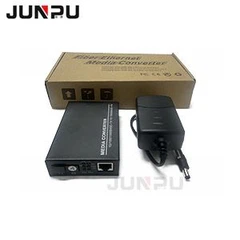
Yes, outdoor fiber optic cable can be integrated with other optical fiber devices. Fiber optic cables are designed to transmit light signals over long distances, and they can be connected to various devices such as fiber optic switches, routers, transceivers, and multiplexers.
To integrate outdoor fiber optic cable with other devices, connectors are used. Connectors are mechanical devices that join the ends of two fiber optic cables together or connect a cable to a device. There are different types of connectors such as SC, LC, ST, and MTP/MPO connectors.
These connectors allow for easy and secure connections between the outdoor fiber optic cable and other devices. They ensure that the light signals transmitted through the cable are efficiently transferred to the connected devices.
Integration of outdoor fiber optic cable with other optical fiber devices is essential for establishing reliable and high-speed communication networks. It enables the seamless transmission of data, voice, and video signals over long distances in various applications such as telecommunications, internet connectivity, and data centers.
How To Maintain Outdoor Fiber Optic Cable
Regular Inspection
Conduct regular inspections of the outdoor fiber optic cable to identify any signs of damage or wear. Look for any cuts, breaks, or loose connections.
Protect From Physical Damage
Install protective measures like conduits, ducts, or underground trenching to shield the fiber optic cable from physical damage. This can prevent accidental cuts or impacts that could disrupt the cable's performance.
Secure Cable Connections
Ensure that cable connections are properly secured and protected. Use weatherproof enclosures or connectors to prevent moisture or dust from entering the cable ends.
Proper Cable Handling
Handle the outdoor fiber optic cable with care to avoid bending or twisting it excessively. Follow manufacturer guidelines for cable installation and handling to prevent damage.
Protect From Environmental Factors
Shield the cable from extreme temperatures, UV radiation, moisture, and other environmental factors. Use appropriate protective measures such as UV-resistant jackets, cable trays, or burying the cable underground.
Regular Cleaning
Clean the cable ends and connectors periodically to remove dust, dirt, or other contaminants that could affect signal transmission. Use lint-free wipes and appropriate cleaning solutions recommended by the manufacturer.
Perform Cable Testing
Regularly test the outdoor fiber optic cable to ensure its performance and detect any potential issues. Use specialized testing equipment to measure signal loss, reflectance, and other parameters.
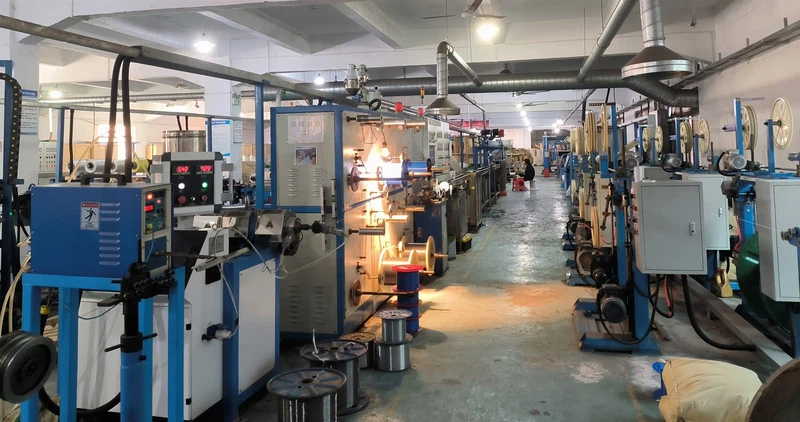
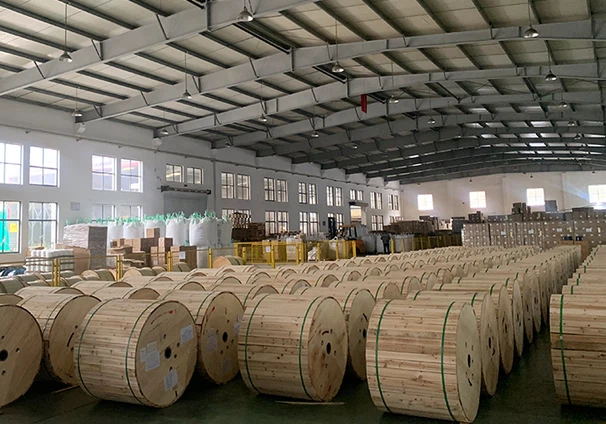
Our Factory
Hangzhou Junpu Optoelectronic Equipment Co.,Ltd . Which specializes in fiber to the home (FTTH) and HFC network for many years. Fiber optic communication equipment includes fiber optic terminal boxes, fiber optic splice boxes, FTTH optical drop-in lines, fiber optic patch cords, fiber optic splitters and EDFA wavelength division multiplexers. Junpu provides complete solutions of standard products or customized in FTTH field.
FAQ
Q: What are the advantages of using outdoor fiber optic cables instead of copper cables?
Q: How is an outdoor fiber optic cable different from an indoor cable?
Q: What are the main components of an outdoor fiber optic cable?
Q: What is the purpose of the central core of an outdoor fiber optic cable?
Q: What are the different types of outdoor fiber optic cable available?
Q: What factors should be considered when selecting an outdoor fiber optic cable?
Q: What is the maximum distance that an outdoor fiber optic cable can cover?
Q: What is the importance of choosing the right type of cable when installing a fiber optic network?
Q: What is an outdoor fiber optic cable?
Q: In what situations would an aerial outdoor fiber optic cable be preferred?
Q: What makes a direct buried outdoor fiber optic cable different from other cables?
Q: What are the applications of outdoor fiber optic cables?
Q: What is the difference between single-mode and multi-mode outdoor fiber optic cables?
Q: How do outdoor fiber optic cables contribute to the advancement of telecommunications?
Q: How do you choose the right outdoor fiber optic cable for your application?
Q: What is the construction of outdoor fiber optic cable?
Q: How do you ensure the compatibility of outdoor fiber optic cables with other networking components?
Q: How do you test the performance of outdoor fiber optic cables?
Q: What are the challenges of installing outdoor fiber optic cables?
Q: What are the advantages of using outdoor fiber optic cables for security systems?
As one of the most professional outdoor fiber optic cable manufacturers and suppliers in China, we're featured by quality products and competitive price. Please rest assured to wholesale cheap outdoor fiber optic cable for sale here from our factory. Contact us for OEM service.
1 Core Fiber Optic Drop Cable,